
Function in JS
A function is a reusable set of instructions.
It is a block of code designed to perform a specific action.
In JavaScript, functions are first-class citizens, which means they can be:
stored in variables
passed as arguments
returned from other functions
Function Declaration
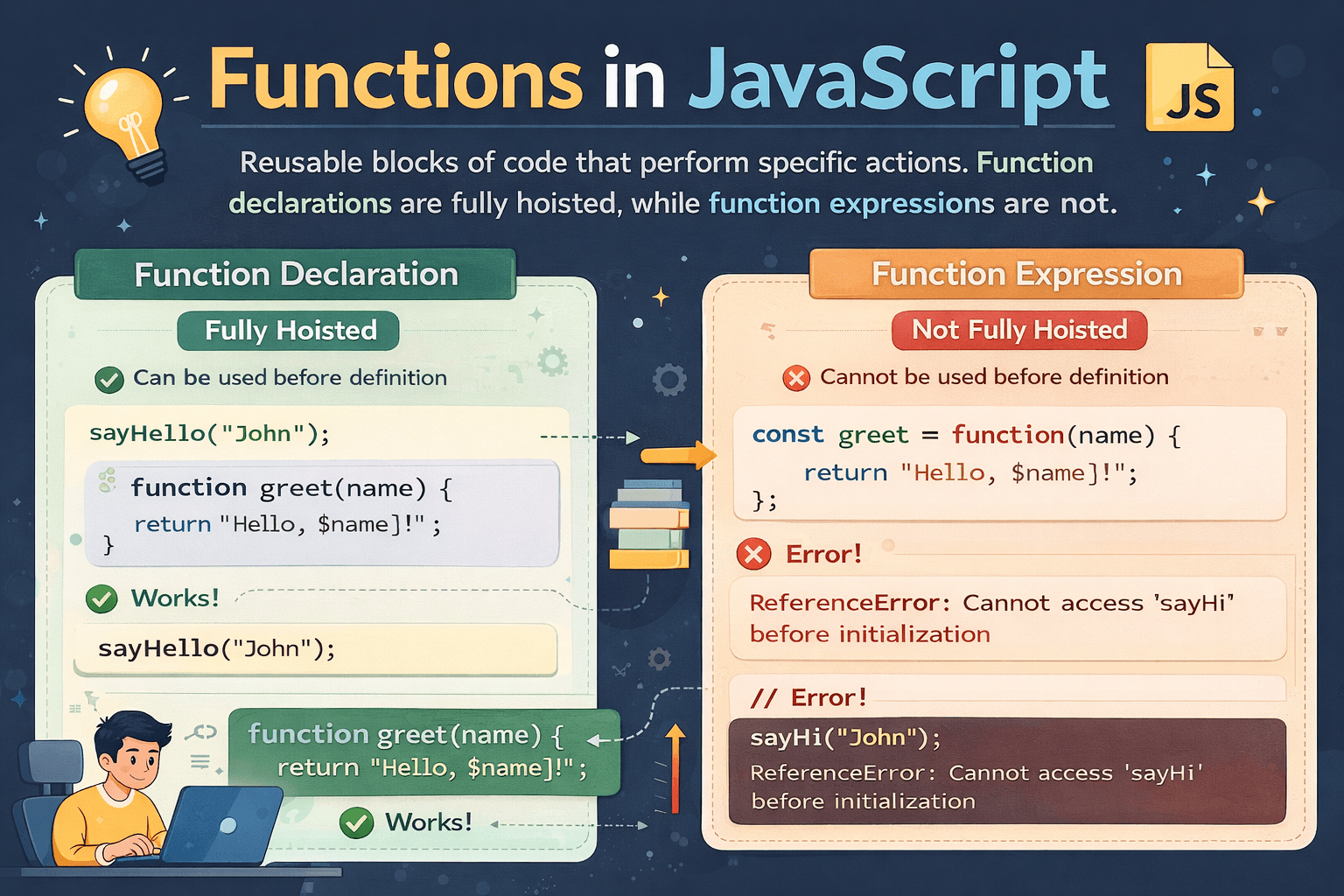
When we write a function with a function name, it is called a function declaration.
Function declarations are fully hoisted in memory, so they can be used before their declaration in the code.
Example:
function greet(name) {
    return `Hello, ${name}!`;
}
Anonymous functions cannot be used directly in function declarations.
Example of an anonymous function:
function() {}
This will not work as a function declaration because it has no name.
Function Expression
When we assign a function to a variable, it is called a function expression.
Function expressions are not fully hoisted, so they cannot be used before they are defined.
Example:
const greet = function(name) {
    return `Hello, ${name}!`;
};
A function expression can be an anonymous function.
Example:
const anonymous = function() {};
It can also be a named function expression.
Example:
const named = function func() {};
Hoisting Difference
We can see the difference using the following examples.
Function Declaration (Works)
sayHello("John"); // "Hello, John!"

function sayHello(name) {
    return `Hello, ${name}!`;
}
Function Expression (Error)
sayHi("John"); // ReferenceError: Cannot access before initialization

const sayHi = function(name) {
    return `Hi, ${name}!`;
};